Guide · Experience design
What is tactical urbanism?
The cheap, reversible way to find out what a street wants — how to run a trial that stands up to scrutiny, and how to carry a pilot through to permanence.
A working definition
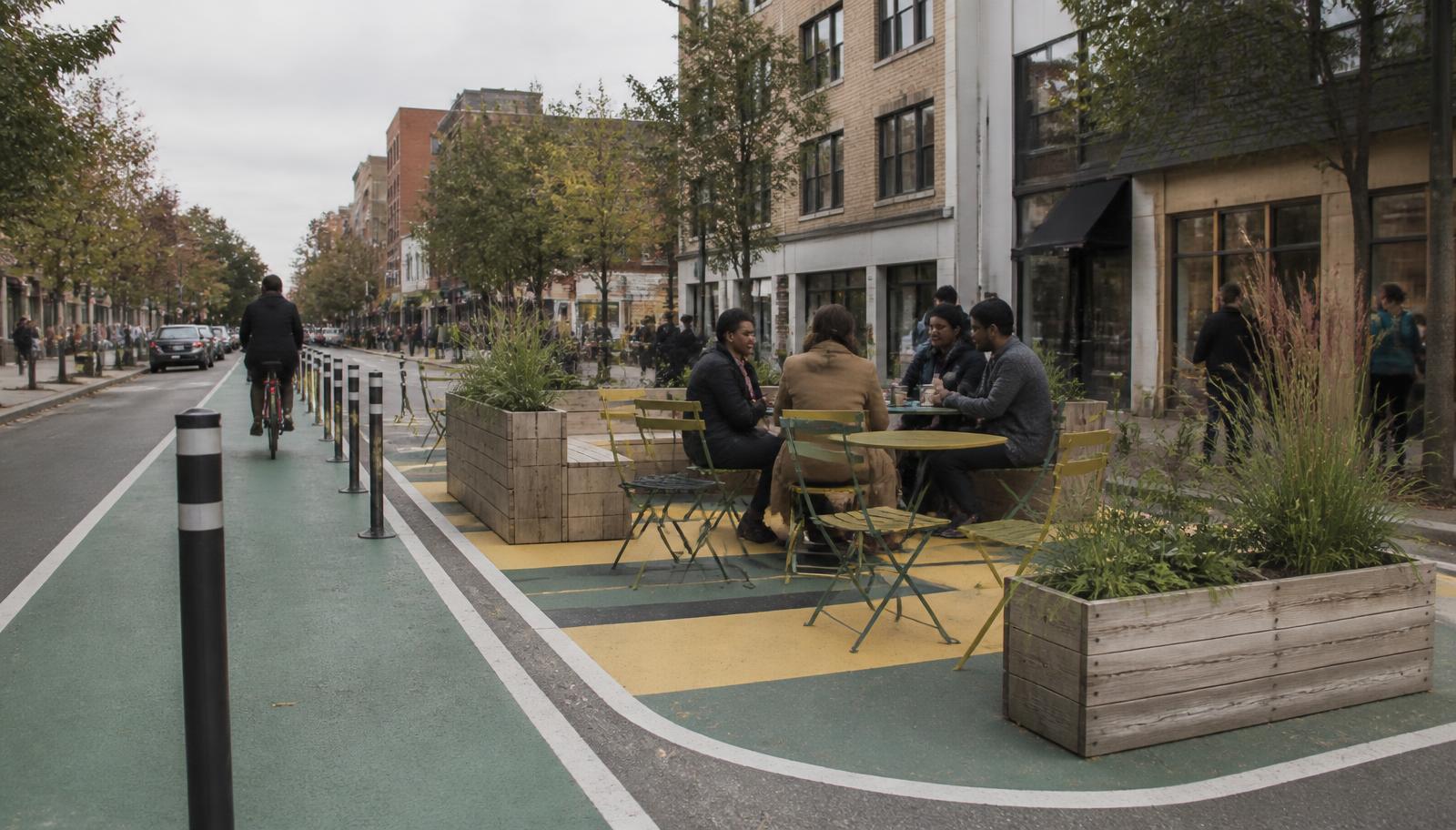
Tactical urbanism is the practice of changing a street with interventions that are short, cheap and reversible — paint, planters, bollards, moveable seating, a temporary closure — and treating each one as a live trial rather than a finished scheme.
The term was coined around 2010 by Mike Lydon and collaborators to describe what residents, traders and, increasingly, city departments were already doing: acting at the scale of a block and the budget of a paint order. Its lineage runs back through New York's plaza programme, Bogotá's ciclovía, and the first parking-day parklets in San Francisco.
What distinguishes it from ordinary small works is intent. A bench installed is an improvement. A bench installed with a baseline, a hypothesis and a review date is an experiment — and the experiment is the point.
Repertoire
Seven interventions that earn their keep
- Parklet. Two parking bays converted to seating and planting. The clearest test of whether a street would rather store cars or hold people.
- Pop-up protected lane. Bollards, paint and planters carving a cycle lane out of carriageway width. Installed in a weekend, counted from day one.
- School street. A timed closure at drop-off and pick-up. High-consent, high-effect, and the intervention parents defend hardest.
- Painted junction. Colour and kerb build-outs to shorten crossings and slow turns, ahead of any concrete.
- Moveable chairs. Whyte's oldest finding, still the highest-return pound a place manager can spend. People rearrange them, and in doing so tell you where the space wants to be used.
- Open street. A regular closed day that lets a district feel a different version of itself before voting on it.
- Meanwhile use. A vacant unit lent to makers, traders or a community group for a season, testing what the frontage could support.
Argument
Why testing beats predicting
A permanent public-realm scheme is a prediction: this width, this surface, this planting, and people will behave in the way the drawing assumed. The prediction is made years before anyone can check it, and by the time it is checkable the money is spent.
Tactical urbanism inverts the sequence. It buys the answer before the capital — for a fraction of a per cent of the eventual budget, with a real street, real weather and real people supplying the evidence. A trial that fails is a saving, and it is worth saying so out loud when one does.
The second dividend is political. An argument about a proposal is an argument about imagined futures, which nobody can win. An argument about a trial is an argument about something everyone has stood in.
Method
Running a trial properly
- Observe first. Watch the street at eight, at one, at six and after dark, on a weekday and a weekend. Write down what it asks for before deciding what to give it.
- State the hypothesis. One sentence, in public: what this intervention is expected to change, and by roughly how much.
- Baseline before you build. The single most-skipped step, and the one that decides whether the trial can prove anything.
- Install fast, finish well. Speed is the method; shabbiness is not. A trial that looks temporary is fine, one that looks abandoned loses the argument in week two.
- Run eight to twelve weeks. Past the novelty, into at least one change of weather.
- Publish the review date at the start. People accept a great deal when they know when it will be reconsidered.
- Decide, visibly. Keep, adjust or remove — and say which evidence drove it.
Evidence
What to measure
Movement counts alone will tell you a street was used. They say little about whether it was enjoyed, which is where a trial usually wins or loses its argument. Take these six before and after, at the same points and times:
- Dwell time — median minutes spent, sampled at four times of day.
- Who is present — age mix, groups against solo users, and whether children and older residents appear unaccompanied.
- Movement by mode — walking, cycling, driving, wheeling, including the streets either side to catch displacement.
- Evening use — activity in the two hours after dark, the sharpest indicator of felt safety.
- Trade at the edge — takings where traders will share them, and vacancy on the adjoining frontages.
- Felt experience — a short repeated survey on comfort, welcome and whether people would choose to linger.
Report the change against a comparable untreated street, and be plain when the sunshine did the work. The method for turning this into a financial case is in the economics of wellbeing.
Candour
Consent and the backlash
Tactical schemes attract heat out of proportion to their cost, usually for three reasons worth answering directly.
- Surprise. Speed is the method's advantage and its liability. Tell the street what is coming, when it will be reviewed, and who decides.
- Parking and access. Traders often overestimate how many customers arrive by car; surveys repeatedly find the share lower than assumed. Count it locally rather than citing somebody else's town, and design loading and blue-badge access in from the start.
- Whose street. Interventions installed for a visiting audience rather than the residents of the block wear out their welcome. Ask who is standing here at nine on a Tuesday, and build for them.
A published baseline, a fixed review date and an honest report do more for consent than any amount of consultation graphics.
Next
From pilot to permanent
The common failure is not a trial that fails. It is a trial that succeeds and then sits in bollards and paint for four years, until the materials weather and the goodwill with them.
Three things carry a pilot across. A decision point written into the programme from the outset. A capital route identified before installation — the scheme it feeds, the fund it fits. And evidence in the form the funder already reads, which usually means wellbeing and trade argued together rather than one at a time.
The wider practice sits in placemaking, the standard it is held to in experience design, and the measurement layer in District Intelligence™. Where a business improvement district runs the area, tactical trials are the cheapest evidence its renewal case can buy.
FAQ
Common questions
- What is tactical urbanism?
- Tactical urbanism is the practice of changing a street or public space with short, low-cost, reversible interventions — paint, planters, moveable seating, temporary closures — used as live trials rather than finished schemes, so a district can learn what works before it commits capital.
- What are examples of tactical urbanism?
- Parklets in parking bays, pop-up protected cycle lanes marked with bollards and paint, open streets days, school-street closures at drop-off and pick-up, painted junctions that shorten crossings, moveable chairs in a square, and pop-up markets in vacant units.
- Is tactical urbanism the same as placemaking?
- Tactical urbanism is one mode of placemaking — the testing mode. Placemaking describes the wider practice of shaping public space around the life people want in it; tactical urbanism is the cheap, reversible way of finding out which of those moves works here.
- How long should a tactical urbanism trial run?
- Long enough to pass through a full cycle of ordinary use and at least one change of weather — usually eight to twelve weeks. Shorter than that and you measure novelty; much longer without a decision and the trial reads as neglect.
- How do you measure whether a tactical intervention worked?
- Take a baseline before installation and repeat it at the same points afterwards: dwell time, who is present by age and group, evening use, movement counts by mode, trade and vacancy on the adjoining frontages, and a short survey on comfort and welcome.
Join
Becoming a District
districtXD is a global network for places designing for how they are experienced — sharing instrumentation, protocols and a common language for what a district returns in wellbeing and in trade. A shared protocol makes one district's trial legible to every other one. Founding Districts help shape the framework and take the first places in the Index.
Apply to become a Founding District
An initiative of XDG Labs · from the makers of the Conscious Cities Index