Guide · Evidence
What is the experience economy?
The ladder from commodity to transformation, why a district sits on it whether or not it means to, and how to claim the rungs above the one you are on.
A working definition
The experience economy is the stage of economic value at which people pay for an encounter they will remember rather than for the thing at the centre of it. Joseph Pine and James Gilmore named it in a 1998 Harvard Business Review essay and the book that followed, and the observation has aged well: as goods and services become easy to copy and cheap to compare, the differentiated part of the offer is what it felt like to be there.
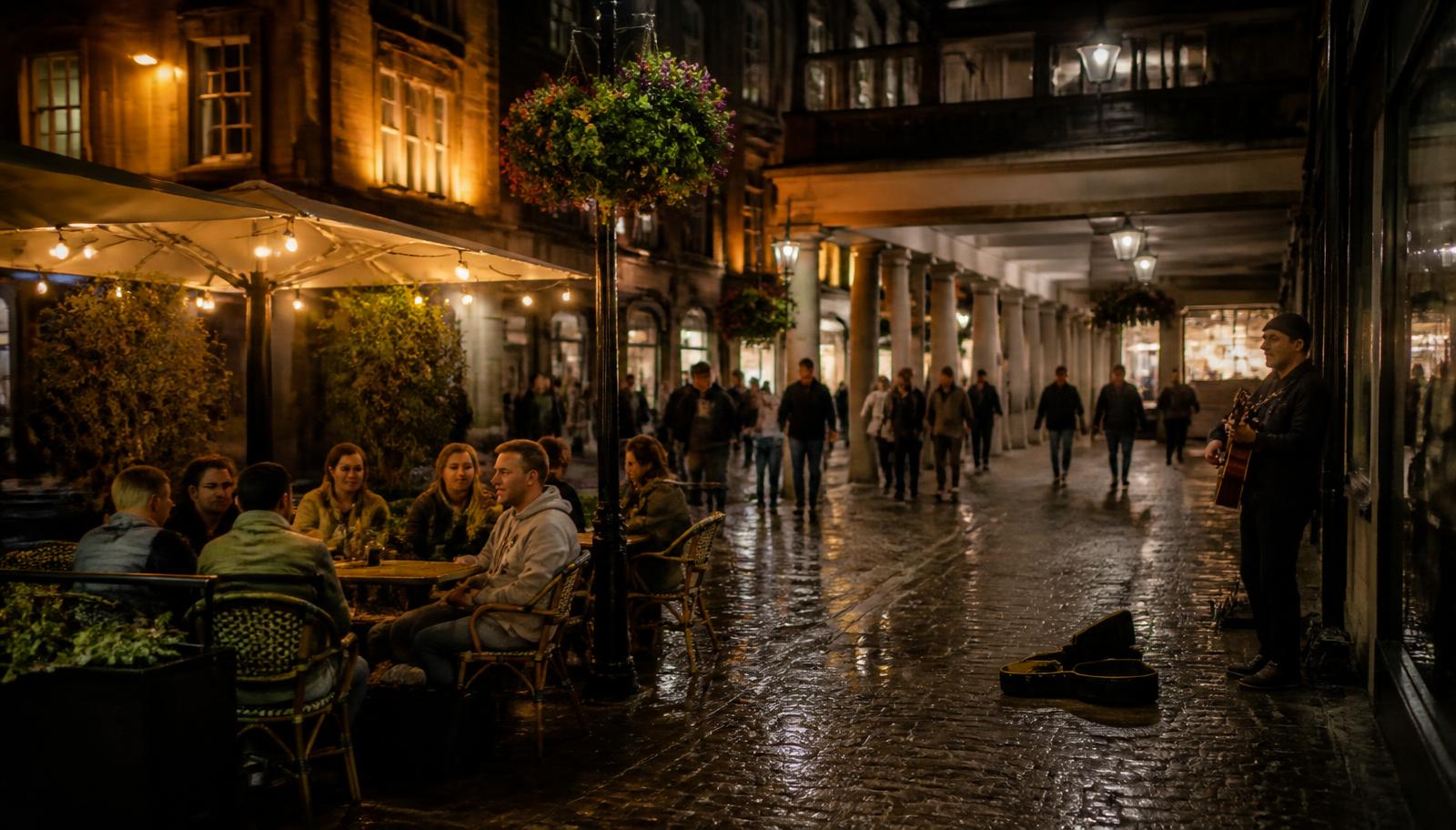
Their illustration is a coffee bean. As a commodity it trades for pennies. Ground and packaged as a good it is worth a little more. Brewed and handed over as a service, more again. Served at a table on a lit street where somebody is playing, with an hour of company in front of you, it carries a price several multiples higher — and people pay it willingly, because the bean was never the purchase.
For a district this is a statement about ground rent, footfall and frontages rather than about coffee. The rung a place occupies on that ladder sets what its floorspace can earn.
Structure
The value ladder
- Commodity. Undifferentiated material sold on price. In a district: parking, a unit of floorspace, a passing transaction.
- Good. Something made and branded. The shop, the product, the thing carried home.
- Service. Something performed on request. The haircut, the meal, the delivery — reliably good and reliably comparable.
- Experience. Something staged and remembered. The market on a Saturday, the lido in August, the square at dusk. Priced by the hour spent rather than the item bought.
- Transformation. Something that leaves the person changed. Fitter, calmer, better connected, more likely to stay. This is where a district's wellbeing return lives.
Each rung earns more from the same underlying material, and each demands more of whoever stages it. A high street competing on price with the internet has picked a fight on the bottom rung. The same street competing on an evening people plan their week around is trading somewhere the internet cannot follow.
Argument
Why a place is the unit
Most writing on the experience economy addresses a firm: how a brand stages an encounter inside its own four walls. The interesting unit for a town is larger. A visitor remembers an evening, and the evening is assembled from a dozen businesses, a bus route, a lit lane, a bench, a busker and the weather. No single operator owns it, and no single operator can fix it.
That is why the experience economy is a public-realm argument. The parts that determine whether the evening happens — light, seating, safety after dark, the width of the pavement, whether the square is somewhere to sit or somewhere to pass through — sit in shared ownership. A district that improves them lifts every frontage on it at once, which is the return that justifies collective spend and the reason business improvement districts exist in the first place.
Retail floorspace makes the point plainly. Anything a shop sells as a transaction is available online at a lower price. What a street still holds exclusively is the fact of being somewhere with other people. Experience is the non-substitutable part of the offer.
Practice
What staging actually takes
Staging is often read as decoration — festoon lights, a mural, a slogan on the hoarding. Those are the cheapest part and the first to wear out. The durable version works on what people sense and do.
- A reason to be there at a given hour. Markets, programmes, late openings, sport, a habit the calendar carries.
- Somewhere to stay. Seating people choose, shade and shelter, and enough of both that arriving does not require a purchase.
- Sensory quality. Light warm enough to sit under, traffic noise low enough to talk over, planting, texture underfoot, air worth breathing.
- Legibility. Knowing where you are, what is around the corner, and how you will get home after dark.
- Sociability. Edges, thresholds and steps where people can watch and be watched — the oldest finding in the literature and still the most reliable.
- A distinctive character. Something particular to here, in the trade mix, the fabric and the programme, that a visitor could describe afterwards.
The method for turning those into decisions rather than intentions is set out in experience design, and the cheapest way to test one is a tactical trial.
Evidence
Measuring the yield
Experience shows up in behaviour before it shows up in accounts. These six move first, and each has a financial counterpart a treasury will recognise.
- Dwell time — median minutes stayed. The closest proxy for whether an hour here is worth spending, and it tracks spend per visit.
- Evening and weekend use — activity outside the working day, where the extra trading hours are.
- Spend per visit — the rung test: the same basket carries a higher figure on a street people want to be on.
- Return and reach — repeat visits, and how far people travelled. A catchment that widens is an experience that travels by word of mouth.
- Frontage health — vacancy, letting periods and rents on the adjoining units, which capitalise the rest.
- Felt quality — a repeated survey on comfort, welcome and belonging, which is what the other five are measuring the shadow of.
Held together over time, these are what District Intelligence™ instruments, and the economics of wellbeing sets out how to price them.
Candour
Where the idea gets misused
Three failures recur often enough to be worth naming.
- Theming instead of substance. A staged encounter with nothing behind it reads as costume. People are fast at spotting a place performing itself, and the second visit is the one that does not happen.
- Designing for the visitor alone. A district tuned for a weekend audience hollows out on a Tuesday. Build for the people standing there at nine in the morning, and the visitor economy follows a place that is already alive.
- Pricing residents out. Experience that arrives only through paid consumption excludes exactly the people whose wellbeing is the point. Keep the free layer — the seat, the shade, the square, the library — generous, because it is the layer everything else is staged on.
Above
Above experience: transformation
Pine and Gilmore placed one rung above experience: transformation, where the customer is the product and the outcome is a change in them. For a business that is a gym or a school. For a district it is the honest description of what good public space does — residents who move more, meet more, sleep better, feel safer after dark and stay longer in the neighbourhood.
That is the same yield read twice. Wellbeing and local trade are one argument: the hour someone chooses to spend on a street is simultaneously a health outcome and a trading one, and separating them is a habit of accounting rather than a fact about places. A district that measures both at once can make a case no single department could make alone.
FAQ
Common questions
- What is the experience economy?
- The experience economy describes the stage of economic value in which people pay for a staged, memorable encounter rather than for a good or a service alone. Pine and Gilmore set it out in 1998: commodities are extracted, goods are made, services are delivered, and experiences are staged — each step commanding a higher price for the same underlying material.
- What are examples of the experience economy?
- A coffee bean sold as a commodity, ground and packaged as a good, brewed as a service, and served on a lit terrace with music and company as an experience. In a district it looks like a night market, a lido, a covered hall of independents, a festival of light, or a square people cross town to sit in.
- Why does the experience economy matter for high streets?
- Anything a high street sells as a transaction can be bought online more cheaply and delivered faster. What cannot be delivered is being somewhere. Experience is the part of retail and hospitality that has no online substitute, which makes it the ground a physical district competes on.
- What is the difference between the experience economy and the transformation economy?
- An experience is something you remember; a transformation is something that changes you. Pine and Gilmore placed transformation above experience as a fifth stage — the gym that leaves you fitter, the district that leaves residents healthier and better connected. For a place, that is the wellbeing return.
- How do you measure the experience economy in a place?
- Measure the behaviours experience produces: dwell time, evening and weekend use, spend per visit, repeat visits, distance travelled to reach the district, vacancy and rent on the frontages, and a repeated survey of comfort, welcome and belonging.
Join
Becoming a District
districtXD is a global network for places designing for how they are experienced — sharing instrumentation, protocols and a common language for what a district returns in wellbeing and in trade. A shared protocol makes one district's evidence legible to every other one. Founding Districts help shape the framework and take the first places in the Index.
Apply to become a Founding District
An initiative of XDG Labs · from the makers of the Conscious Cities Index